Branching Out: Music Theory Pedagogy’s Ramist Turn
Mar 7, 2026·
Caleb Mutch
Abstract
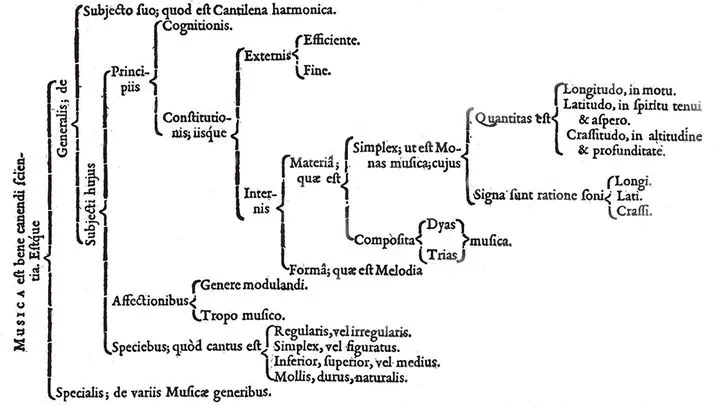
In 1676–77, W.C. Printz published Phrynis, a lengthy treatise which compiles much of the German music theory of the preceding generation. In it, he innovatively named and described over a dozen kinds of cadence, many of which had never before been considered to constitute distinct cadential types. Though later scholars like F.W. Marpurg mocked this account of cadence as needlessly complicated and idiosyncratic, I argue that it in fact reflects its author’s indebtedness to a century-old pedagogical tradition spearheaded by the innovative French educator Petrus Ramus (1515-72). Known as Ramism, this pedagogical movement rejected traditional Aristotelian-Scholastic approaches in favour of newly composed, simplified texts that aimed to make education more accessible. Ramist instruction characteristically emphasized the logical, systematic arrangement of ideas, such that content could be depicted spatially, particularly in the form of branching diagrams. These practices were adopted by many music educators, as evinced by theory treatises from the late sixteenth and early seventeenth centuries that employ such diagrams. I consider the effect of Ramism on those texts by comparing their organization with contemporaneous, non-Ramist theory treatises. Although by the mid-seventeenth century these diagrams had evidently fallen out of fashion, the underlying systematic organization nonetheless remained attractive, as is evident both in Printz’s presentation of his cadential ideas and also in his structuring of the whole ars musica in his Compendium musicae (1668). In doing so, I demonstrate how a widespread movement of pedagogical reform exerted a significant, sustained influence on music-theoretical education.
Date
Mar 7, 2026
Location
The Hague, Netherlands